Kingdom
Maryame El Moutamid: The Moroccan Astrophysicist Who Wants to Lead a Space Mission Around Saturn
Maryame El Moutamid currently leads a team of astrophysicists working on one of the programs of the American James Webb Space Telescope (JWST) selected in 2024.

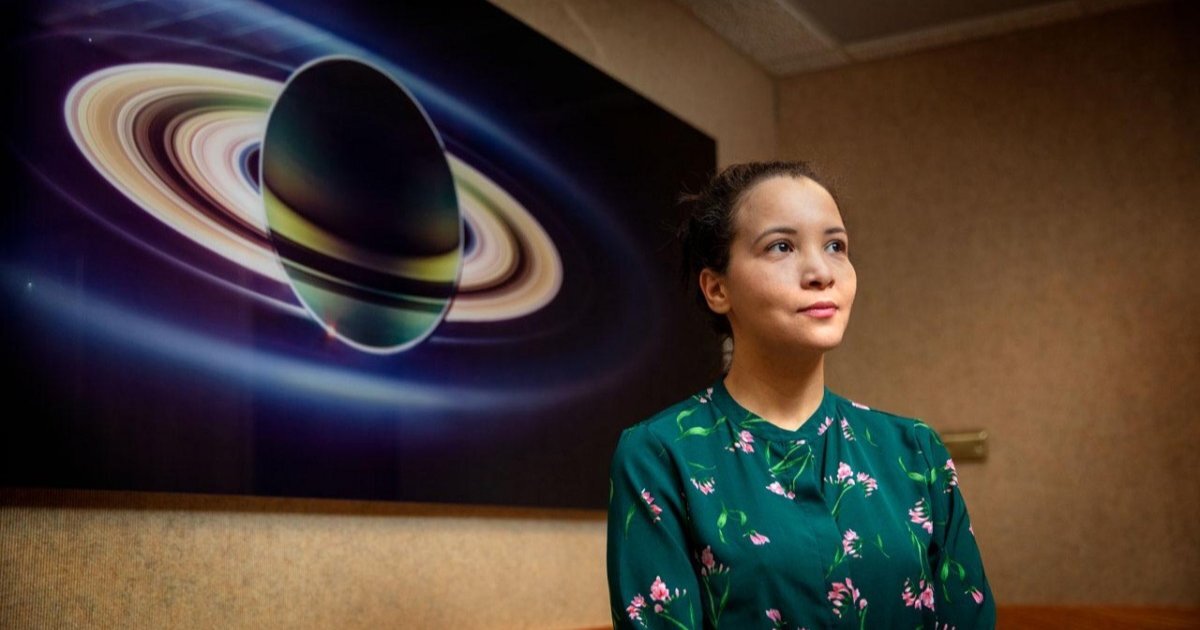
Since a very young age, Maryame El Moutamid has always had her feet on the ground and her head in the stars.
Today, at 41, she leads a team of astrophysicists working on one of the programs of the American James Webb Space Telescope (JWST) selected in 2024, behind the recent discovery of a small celestial body previously unknown, orbiting the planet Uranus.
An important scientific achievement that helps further unravel the mysteries and subtleties of the planets and celestial bodies that make up our solar system.
El Moutamid and her team discovered this tiny satellite, which orbits the giant ice planet Uranus, during an observation mission carried out last year using the powerful JWST space telescope of the American space agency NASA.
This meticulous in-depth work reflects the level of expertise and dedication of the Moroccan scientist, who does not hide her fascination and long-standing interest in observing planets, particularly Uranus and Saturn.
“I am convinced that this discovery will pave the way for others, because as technology advances it allows us to discover more and more things in the solar system,” she told MAP.
A passion for discovery and scientific research that this native of Essaouira has developed since her years in the Moroccan public school system.
Her interest and dedication to science and astrophysics grew even stronger after higher education in France and the United States, where she notably completed her postdoctoral stay at the prestigious Cornell University (New York).
A success that she mainly attributes to perseverance and the importance of self-confidence.
In this regard, she wishes to encourage young Moroccan women and men who are interested in space “to go for it, to never underestimate themselves, and to seize opportunities to work with scientists from all over the world.”
“One should not hesitate to look for opportunities to observe space in general and planets in particular. I am certain that there are celestial bodies out there waiting to be discovered for the first time.”
Speaking of discoveries, Maryame El Moutamid says that her medium-term objective is to lead an unmanned space mission around the planet Saturn in order to study its rings and satellites, particularly those that contain liquid oceans, with the aim of understanding their geological formation and dynamic evolution.
For the moment, however, the Moroccan scientist and her team continue to further unravel the mysteries of Uranus, nicknamed the “tilted planet,” and the seventh planet of the solar system.
Maryame El Moutamid says she chose to study Uranus precisely because it is a “poorly known planet,” with a rotational axis tilted more than 90° relative to its orbital plane, which facilitates the observation of its rings and satellites.
Another reason to study Uranus, she adds, is the narrow and well-confined nature of its rings, which require a “shepherding” mechanism to prevent the particles from dispersing.
Mission to be continued!