Kingdom
Homage. Hamidi is Gone…
Mohamed Hamidi passed away on Monday at the age of 84, taking with him the erotic pulsations of an abstraction that made post-colonial Moroccan art vibrate. His brush, erotic in its essence, fades into free forms: hard-edge breasts and vulvas in chromatic symbiosis. Farewell, maestro of unfettered forms, you leave our canvases orphaned and our souls a little more naked, a little more hungry for your fire.

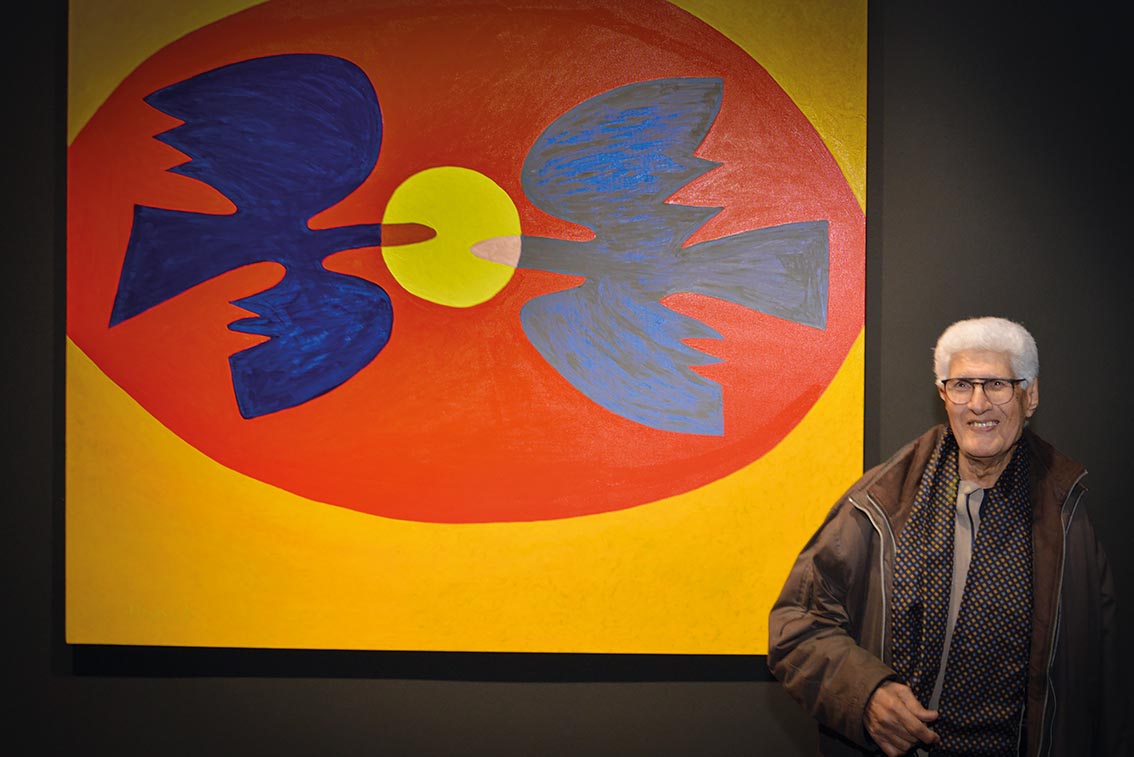
He passed away this Monday, October 6, at the age of 84, like a brushstroke that fades softly upon a vibrant canvas. Mohamed Hamidi, this discreet giant of post-colonial Moroccan art, leaves us with forms that still move, colors that still vibrate, and an abstract eroticism that tickles the unconscious.
A major figure of the Casablanca School, he never sought to copy the world: he reinvented it, stripping it down to its symbolic bone. Farewell, Hamidi. Your brush will be missed, but your stylized breasts and hard-edge phalluses will continue to haunt the galleries.
Born in 1941 in the tumult of Casablanca, under a French protectorate already crumbling, Hamidi grew up with the noise of the ports and the scent of spices. A graduate of the Casablanca School of Fine Arts in 1958, he left for Paris in 1966, to the frescoists, under the wing of Jean Aujame. There, it was pure bohemia: grimy studios, haunted museums, squatted galleries. He soaks it in, he absorbs, he vomits up the figurative only to better transcend it.
Returning home in 1967, he joined the teaching staff of the Casablanca School of Fine Arts alongside the titans Farid Belkahia, Mohamed Melehi and Mohamed Chebâa. Those guys were the punks of Maghrebi art: they dynamited conventions, marrying local craftsmanship with Western modernity. And Hamidi, with his keen eye, contributed his part.
Think of 1969: the manifesto-exhibition “Plastic Presence” in the mythical Jemaa el-Fna square. Berber carpets rubbed shoulders with abstract canvases, Moroccan craftsmanship flirted with pop art. Hamidi was there, on the front line, explicating this visceral link between tradition and rupture. “It is the life impulse allowed by sexuality and eroticism that the artist intends to evoke for us,” wrote critic Syham Weigant in a catalogue, deciphering these obsessions with the “origins of the world” – isolated breasts, vulvas in abstraction, dancing phalluses.
No mawkishness here: Hamidi did not deal in prudishness. He liberated the body, stylized it into erotic geometry, and hurled it onto the canvas like a chromatic burst.
For that is Hamidi’s punch: his abstraction is not cold, it pulses. Straight lines, simple geometric forms, forged under mad latitudes – abrupt transitions between zones of color that ignite. Contrasted, sharp, sudden: and yet, the whole breathes harmony. No garish motley, no: a serenity that caresses, a balance that soothes the soul.
His symbols interweave, blending into a jubilant symbiosis – the mark of an extraordinary talent that moves from Arabo-African aesthetics to a stripped, nuanced, human abstraction. Hard-edge, yes, but with an organic, sexual exaltation that makes puritans blush.
“Each symbolic form awakens in us latent, yet profoundly deep feelings,” the artist himself stated. “It records, beneath the interlacing of lines, the universal concepts that govern our dreams, our deepest unconscious. Color operates to the same degree: every hue is invested with an energy, containing myths and symbols.”
Today, two days after his passing, Morocco mourns a builder. One of the pioneers of modern art, a tireless pedagogue, Hamidi blazed the trail for a generation that dares abstraction without denying its roots. His canvases? Invitations to chromatic ecstasy, reminders that post-colonial art is not a trend: it is an intimate revolution. Rest in free forms, maestro. And we, we will go scour the galleries to capture a little more of your fire.