Kingdom
Dance on Its Points and Its Pitfalls
Between abundant creativity and international recognition, our choreographic scene is bubbling like never before. Taoufiq Izeddiou, an emblematic figure of dance, draws a mixed assessment: on one hand, a generation of choreographers conquering the world and leading festivals that enrich the landscape; on the other, the glaring absence of dedicated venues and a true local market. Insights.

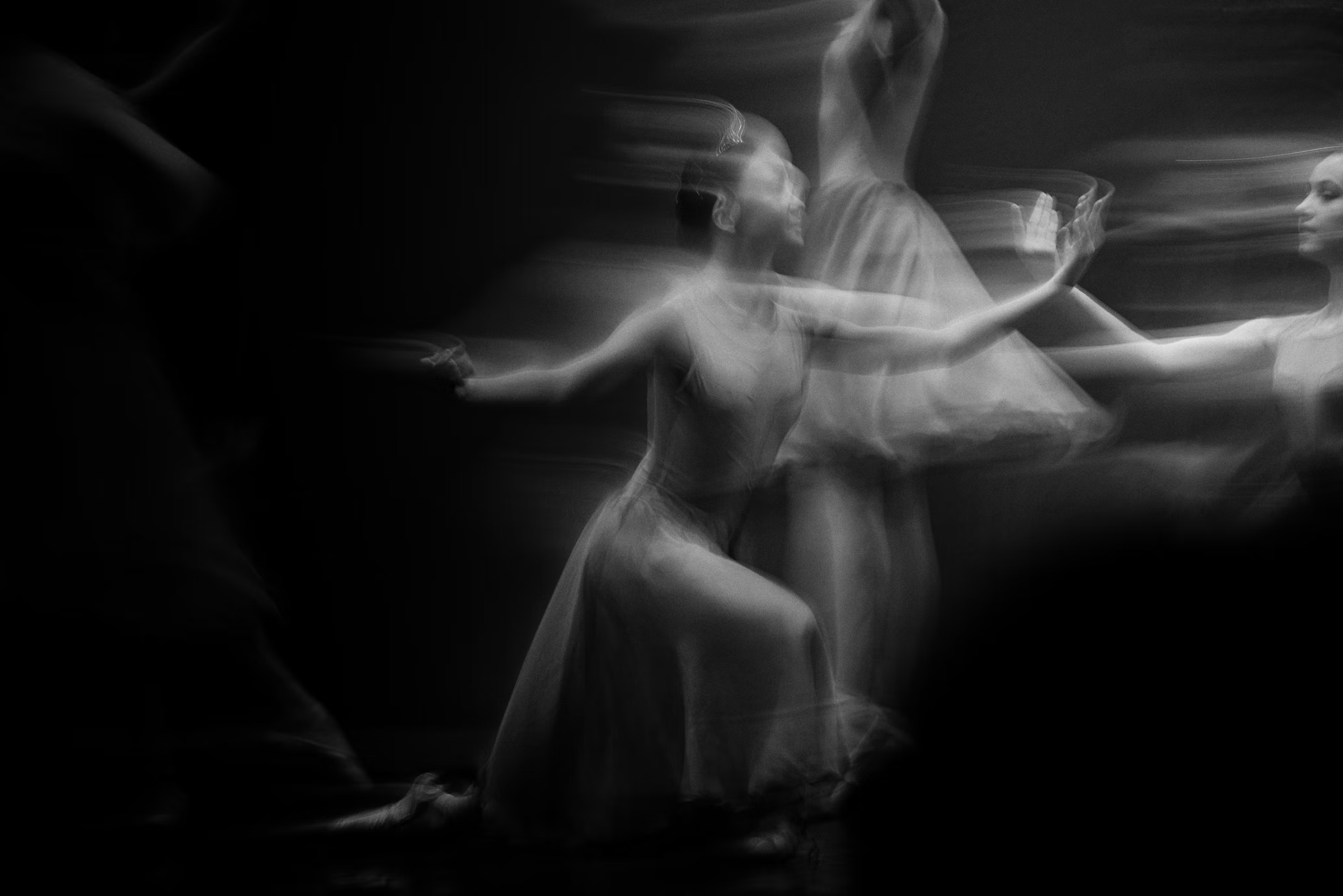
Five days of sweat and tense silences, and Casablanca still exhales the adrenaline of bodies in fusion. In early October, the 11th edition of the Rencontres Chorégraphiques de Casablanca (RCC) transformed the white city into a true open arena, where Arab contemporary dance confronts borders, precarity, and oblivion.
Led by the company Col’jam—the incandescent duo of Ahlam El Morsli and Wajdi Gagui, who have been shaping the Moroccan scene for sixteen years—the event, blessed by the Ministry of Youth, Culture, and Communication, launched the Arab Dance Platform.
A masterstroke: an unprecedented showcase for talents from the Arab world, lifting Casa far from the unequal circuits that drown works in obscurity.
Twenty shows, an explosive mosaic from Tunisia, Palestine, Jordan, Lebanon, Poland, Switzerland, France, Italy, Germany, Spain, and, of course, Morocco.
Powerful performances: bodies colliding with the walls of daily life, urban gestures taking over public squares, silences screaming taboos.
Add a fierce battle for young street dancers (those traceurs who turn pavement into trampolines) and an inclusive ball where amateurs and pros mingle in joyful anarchy.
Mostly free, accessible to all: Col’jam doesn’t joke around with democratization. “It’s a social commitment as much as an artistic cry,” insists Ahlam El Morsli, co-director, who sees in these RCC a lever to “structure the sector, professionalize artists, and build bridges internationally.”
Professionalization
On October 3rd, a pro round brought together the heavyweights of the MENA region: tough discussions on cultural cooperation, sustainable partnerships, and that abyssal void still gnawing at Arab dance.
Masterclasses, workshops, residencies: the event didn’t skimp on transmission, equipping Moroccan choreographers to conquer global stages. But behind the spotlights, a precarious vitality pulses.
Taoufiq Izeddiou, that bridge between Marrakech and Paris, choreographer of Cie Anania and brains behind the festival On Marche (in its twentieth edition, the “mother” of all these gatherings), gives an unvarnished assessment. “Today, we’re seeing authentic, dynamic creativity. Many young choreographers are emerging in great numbers,” he says, citing the Taklîf competition he’s led for four years. Gems like Yassmine Benchrifa, Abdel Mounim Elallami, Mohamed Lamqayssi, Chourouk El Mahati, or Mehdi Dahkan are the fruits: an annual mentorship catapulting the new generation onto the stage.
And the elders? “My generation continues to produce creations. They’re true artists performing internationally: Bouchra Ouizgan, Khaled Ben Gharib, Maryam Jazouli, Ahlam Morsli, Taoufiq Izeddiou,” he lists, proud of recognition spanning the globe. Radouan Mriziga in Belgium, Youness Khoukhou over there too…
Moroccan dance is no longer a mirage: it infuses residencies, tours, and near-constant events. “There’s sustained activity and undeniable vitality,” summarizes Izeddiou. The RCC fit into this maelstrom, alongside On Marche and the initiative Dati Drouk in Rabat, which blends dance and education with Salima Moumni.
“These structures are solidly established and work directly with youth. They train, disseminate, connect,” he emphasizes. On Marche remains the benchmark, with its well-honed balance, but all “do their best within their means.”
Structuring
On the support side, a fresh wind under the Bensaïd era: “There’s been notable progress, especially for festival support.” On Marche signs a three-year agreement with the ministry—festival, training, and the Caravan of Bodies for rural areas, whose third edition is slated for December.
The RCC sport an official label, same for Dati Drouk. International orgs—French Institute, Goethe, Cervantes, British Council, and the Swiss joining in—remain pillars.
In Marrakech, the city and region are loyal, private entities like the Saadi or YSL inject funds, and “friends”—fans, restaurants—fill gaps. “We’re making it, despite obstacles. We manage to accomplish things today.”
But the punch lies in the shortcomings. “Dance needs real status at the ministry. A structured state plan should be established,” thunders Izeddiou.
Because youth, trained hastily, retrain as teachers without a safety net: “That can lead to mistakes, especially with bodies, and particularly with children.”
And venues? “Dedicated spaces are missing. Apart from the Institute of Choreographic Arts and Music in Rabat, recent but opaque, no clear info reaches us.”
No theaters, no youth centers to rehearse, archive, teach, interact. “It hugely hinders development, and I don’t sense urgency from current officials. It’s a glaring lack.”
Worse: a ghost domestic market. “Most creations perform internationally. European and Asian audiences appreciate our works. But for the Moroccan public, outside the French Institutes, there’s not much.”
No ministerial plan to disseminate, educate, federate. “Everything is ready though: pedagogy, creativity, know-how. Many people have accumulated years in the field. But a unifying project where all these people would come together is missing.”
And public space? “It’s an unexpected domain where dance is absent and a strong presence is truly lacking.”
The RCC, with their Arab Dance Platform, fill a gap: visibility for emerging artists, MENA-world exchanges, shared innovation. A celebration of boiling diversity and openness defying norms.
In Casablanca, dance is a body in revolt, a social bond suturing fractures. Izeddiou concludes on a tense note: “That’s the gist.” But we know: the next edition will be even stronger. The bodies don’t stop. They advance.