Kingdom
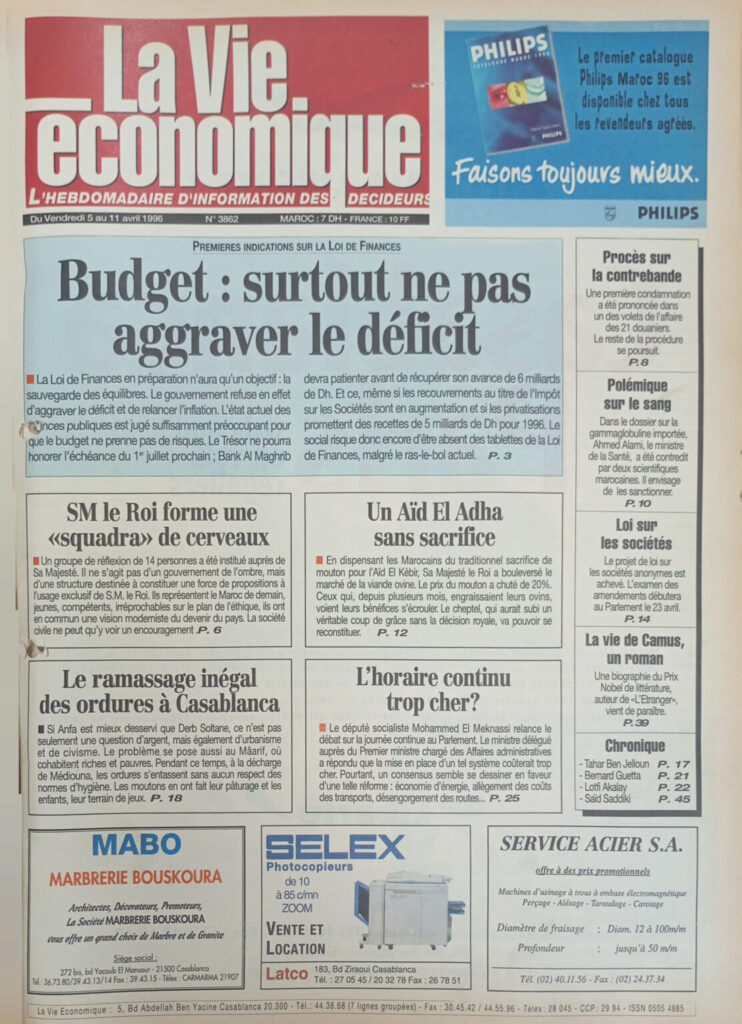
Archives 1996: G14, a “squadra” of brains
Thirty years ago, the establishment of a think tank attached to His Majesty the King was an innovative move. However, it was a structure that did not compete with any other. What remains are the political interpretations.


A think tank of 14 members has been established under His Majesty.
It is not a shadow government, but a structure intended to serve as a source of proposals exclusively for His Majesty the King. These individuals represent the Morocco of tomorrow—young, competent, ethically irreproachable—and they share a modernist vision of the country’s future. Civil society can only see this as an encouragement.
Thus, on Monday, April 1, His Majesty the King appointed this think tank composed of 14 members. On the agenda for this new structure: the development of a growth strategy and responses to short-term challenges. This mandate and the group’s composition quickly sparked commentary: “It’s a shadow government.”
However, the official statement makes it clear: “This group aligns with the approach of a ‘think tank’ and will not interfere in any way with governmental or other institutions.”
The approach is innovative: it is neither a body of new advisers to the Sovereign, nor a legislative structure, and even less an executive one. The 14 members have been appointed and entrusted with a mission under His Majesty, without remuneration, the statement specifies. Transparency was taken further by explaining the selection criteria: similarity of educational backgrounds, complementarity of profiles, shared approach to issues, etc.
Bound by confidentiality
The members also share the same approach to their new mission: “It is a matter of reflecting, at the request of His Majesty, on specific or more general issues, and making proposals.”
What kinds of matters will they examine? The answers are more evasive: “Developing a growth strategy is very broad,” or more bluntly: “Whatever His Majesty asks of us.”
No more will be known: they are bound by confidentiality. Yet the statement specified that the group was created to “contribute to the ongoing debate.” But they do not intend to do so in a visible manner. As for how it will operate, “it will be collegial, but no one says more.”
A recognition for civil society
Nor should one expect the members to engage in speculation. “This group is a structure that competes with none other.” Period. However, they acknowledge that the predominance of the 35–45 age group and the presence of two women are not coincidental.
And the signals do not stop there. The individual backgrounds are too telling to suggest that the selection was random. Within this group are men and women clearly committed to the modernization of the country.
They all come from civil society, which should see this as a form of recognition. The government and political parties are not targeted by the creation of this group.
It is in no way a disavowal of their capabilities—at least, that is what is assured by a “generally well-informed source.” But if the existence of such a body were to encourage deeper reflection, no one would complain.
J.B.
Members of the think tank:
• Mourad Chérif
• Abdeslam Ahizoune
• Mohamed Hassad
• Driss Benhima
• Adil Douiri
• Mostafa Terrab
• Saâd Bendidi
• Aziz Akhannouch
• Omar Slaoui
• Ahmed Ghazali
• Aïcha Benamour Bennis
• Saâdia Belmir
• Hassan Ben Abderrazik
• Mohamed Bijaad