Kingdom
100 Moroccans Who Made History: Mouna Hachim Revisited Morocco’s Plural Memory
Through one hundred striking portraits, Mouna Hachim sheds light on the diversity of Moroccan history and pays tribute to major—sometimes forgotten—figures whose life journeys have shaped some of the Kingdom’s most significant chapters.

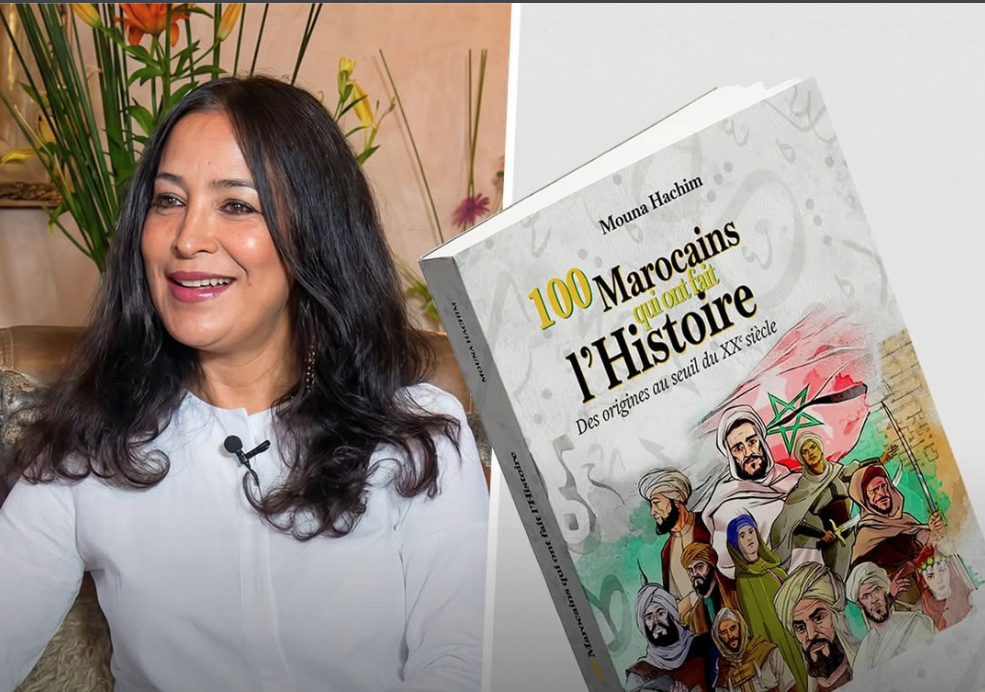
There was a crowd on Thursday evening in Casablanca—and not only in the hall. Present too were Baga, the Moorish king of the 3rd century BCE; Kenza al‑Aourabiya, the political matriarch of the Idrisids; Tarif Ibn Malik, the forgotten scout of al‑Andalus. Women erased from the chronicles. Dissidents, scholars, outsiders, diplomats. All were summoned by Mouna Hachim for the launch of “100 Moroccans Who Made History – From the Origins to the Threshold of the 20th Century”, a 513‑page volume published by Le360. A literary launch, certainly—but above all, a small narrative insurrection. For this book seeks to correct the way history is told.
For decades, Moroccan history has often been transmitted through dynastic corridors (dates, reigns, battles, successions): a vertical account without faces. Mouna Hachim takes the opposite approach. She replaces the line with a constellation. One hundred portraits spanning more than twenty centuries, from the ancient Mauretanian kingdom to the threshold of the 20th century. Not the “most famous,” she specifies, but the “most illuminating.” Everything is there. The aim is to choose those who reveal an era, a rupture, a circulation, a forgotten moment.
The author, who says she came to history through literature, embraces a transversal approach. Disciplines enter freely. Linguistics, anthropology, local memory, classical chronicles, European archives, contemporary academic research—all are present. The result is anything but a collage. It is a mobile narrative, nourished by multiple sources, which refuses the trap of a monolingual national novel.
Perhaps the most stimulating aspect is her way of shifting perspectives. The Morocco depicted in the book is not only that of imperial capitals or palaces. It is also the margins, the mountains, the plains, the Rif, the desert, small forgotten towns, peripheral zones where major historical bifurcations are sometimes forged. A human cartography rather than an atlas of power.
Hence the powerful opening gesture of beginning the book with Baga, an ancient ruler documented through the Punic Wars—a way of reminding readers that Moroccan history does not begin with Islam or the Idrisids, contrary to a still-persistent school narrative. Before the Islamic epic, there were kingdoms, Mediterranean alliances, political strategies, and complex interactions with Rome and Carthage.
The book also insists on periods that official narratives often skirt around: the principalities of Nekor, Sijilmassa, the Berghouata—political formations prior to or parallel with the great canonised narratives. Heterodox religious experiences, regional autonomies, counter‑models. In short, living history—and therefore contradictory.
And then there are the women. Sixteen portraits out of one hundred. The figure may seem modest; it already constitutes an act of reparation in a historiographical field long written “by men and for men,” Hachim reminds us. Kenza, counsellor and strategist. Atika, a figure of dynastic continuity. Others too—warriors, scholars, mediators—rendered invisible and then recovered. The book does not add them as an appendix; it reintegrates them into the historical machinery.
This question of visibility runs through the entire work. Who deserves a place in the national narrative? Only kings? Victors? Bearers of seals? Hachim answers through a diversity of profiles. A great notable may stand alongside an obscure poet, a Christian exarch, a Jewish scholar, a local resister, a forgotten navigator. History ceases to be a ceremonial hall and becomes a busy street once again.
Style plays its part in this reopening. Without sacrificing rigour, the author seeks clarity, rhythm, embodiment. One senses the audiovisual matrix of the project (a weekly series broadcast over two and a half years in Arabic and French). But the move to the book allows what short formats cannot: continuity, echoes, dialogue between centuries. The dead respond to one another across time.
Ultimately, 100 Moroccans Who Made History poses a simple and essential question: what does a country remember, and whom does it forget in the act of remembering? In doing so, Mouna Hachim opens a chantier—a field of work. And that is undoubtedly the best news of this Moroccan literary spring.