Business
LabelVie–Retail Holding: A New Heavyweight in Retail Distribution
The merger by absorption of LabelVie by Retail Holding marks the emergence of a multi‑brand group spanning distribution, food service, and services. The transaction will be carried out through a share exchange and will take place simultaneously with a listing on the Casablanca Stock Exchange, without any subscription procedures.

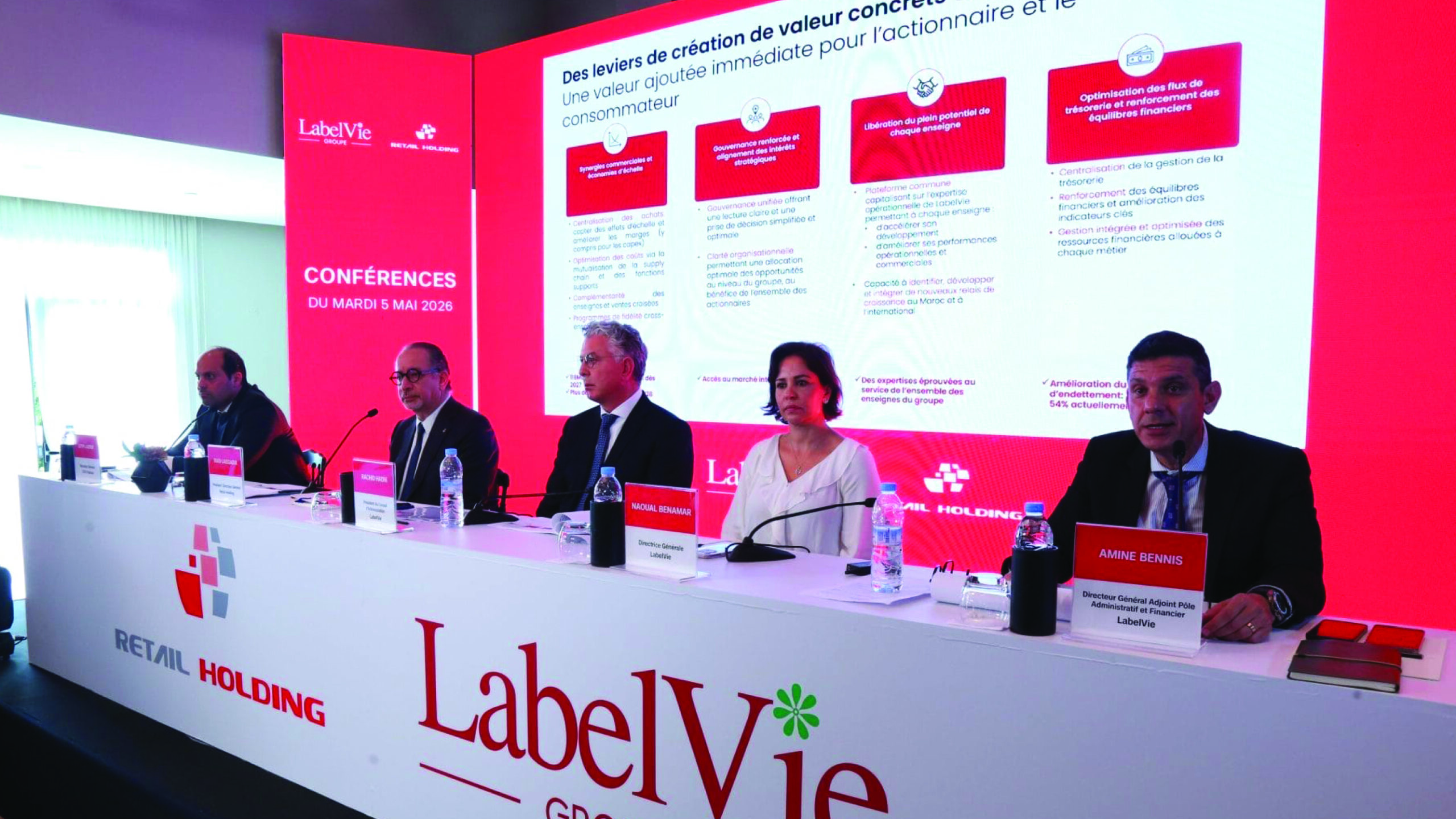
The retail distribution sector is entering a new phase of consolidation through a merger by absorption of LabelVie by its parent company, Retail Holding.
This transaction will give rise to an integrated, multi‑brand, and multi‑activity group. The ambition is to build a major retail player—fully integrated, capable of covering multiple segments and positioning itself beyond the national market.
“This transaction results from a strategic rapprochement between two partners with a long shared history and a common vision, offering strong complementarity and significant synergies,” said Amine Bennis, Deputy Chief Executive Officer in charge of the administrative and financial division at LabelVie.
This repositioning follows a logic of integration and diversification aimed at capturing greater value across the entire value chain. The future group will rest on a solid foundation in large‑scale distribution, with the Carrefour, Atacadão, and Supeco brands, which together operate a network of 411 stores across 37 cities, while also integrating complementary high‑potential activities.
Ready‑to‑wear fashion with Kiabi, fast food with Burger King, cultural retail with Brands & Corners (formerly Virgin), as well as collective catering (Ansamble) and facility management through OCS, will further enrich the business model. The new entity presents strong growth prospects, with a 2026–2030 business plan illustrating a clear ramp‑up phase.
Consolidated revenue is expected to reach 47 billion dirhams by 2030, compared with 21.7 billion dirhams in 2025, representing an average annual growth rate of 16.7%.
While LabelVie’s core activity is expected to generate revenues of 36 billion dirhams, the other brands are expected to contribute an additional 11 billion dirhams. Over the same period, EBITDA is projected to rise to 3.8 billion dirhams, compared with 1.7 billion dirhams in 2025—a compound annual growth rate of 17.5%—corresponding to a margin of 8.5%, up from 5.5% at the end of 2025.
This growth includes an additional contribution of approximately 700 million dirhams, driven both by organic growth and by the contribution of new activities and synergies.
An Exchange Ratio of Eight for Eleven
Ultimately, net profit is expected to exceed 1.4 billion dirhams, reflecting an average annual growth rate of 28.9%. Of this amount, 1.1 billion dirhams will be generated by LabelVie on a standalone basis, compared with 593 million dirhams at the end of the 2025 financial year. The group’s other segments are expected to generate profits of 345 million dirhams, compared with a loss of 190 million dirhams last year.
The transaction should also strengthen financial balances. LabelVie’s debt ratio, which stood at 55%, is expected to improve to 38% post‑merger by the end of 2026 and reach 33% by 2030.
The new group also plans to finance nearly 10 billion dirhams in investments through its self‑financing capacity, while maintaining an attractive dividend distribution policy with a payout ratio of between 55% and 60%.
The financial structuring of the transaction is based on distinct valuation methods tailored to each entity’s profile. LabelVie was valued on the basis of its weighted average market price on the stock exchange, calculated over three‑ and six‑month periods, reflecting a market‑based approach.
Retail Holding, for its part, was valued using the Sum of the Parts (SOTP) method, which consists of separately valuing each of its activities before aggregation. This approach is justified by the group’s diversified nature, with operations spanning distribution, food service, leisure, and ready‑to‑wear fashion.
On this basis, equity value stands at nearly 12.5 billion dirhams for LabelVie and approximately 6.9 billion dirhams for Retail Holding, with LabelVie accounting for nearly 90% of Retail Holding’s valuation. These parameters led to an exchange ratio of 8 Retail Holding shares for 11 LabelVie shares.
A new entity will thus be listed on the stock exchange, without an IPO and without a cash component. The transaction will be carried out exclusively through a share exchange. LabelVie shareholders will therefore automatically become shareholders of Retail Holding, without any subscription procedures.
Identified Synergies
Operationally, the merger will create multiple growth drivers and generate commercial synergies between the various brands.
Geographically, expansion into West Africa—particularly through CDCI in Côte d’Ivoire—represents a key strategic axis with significant scaling potential. The development plan provides for the opening of 400 retail outlets over the next five years, compared with 125 currently.
Value creation also rests on an industrial logic that benefits both shareholders and consumers. The integration of activities should generate economies of scale through centralised procurement and increased purchasing volumes.
Supply‑chain optimisation and the pooling of support functions will further strengthen operational efficiency. This will be complemented by cross‑selling between brands and the rollout of integrated loyalty programmes.
These levers are expected to generate additional EBITDA of an estimated 118 million dirhams as early as 2027, rising to over 166 million dirhams from 2028 onward. Finally, another major benefit of the transaction lies in the simplification of the group’s structure. The new entity will feature centralised governance, offering greater clarity to investors and improved decision‑making efficiency.
Moreover, this merger will unlock the full potential of each brand and optimise cash flows through integrated financial management and a strengthening of financial discipline across all business lines.
Authorisation: AMMC Visa Expected in July
The terms of the merger by absorption were approved by the boards of directors of both entities, which met on 4 May. However, the transaction remains subject to regulatory approvals, notably the visa from the Moroccan Capital Markets Authority (AMMC) and the approval of the extraordinary general meetings of both companies.
Top management expects to obtain the regulator’s approval between mid‑July and the end of July. The merger is therefore expected to take effect at the beginning of August. Once finalised, the transaction will have retroactive effect from 1 January of this year.